

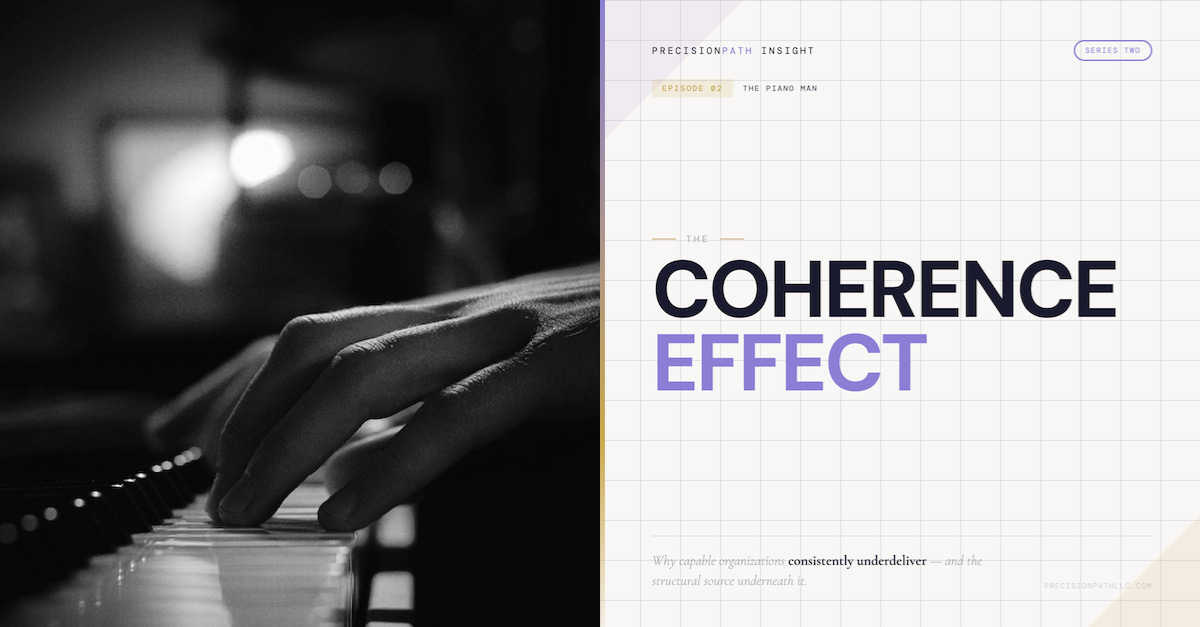
We were sitting at a bar on Sixth Street in Austin — a team blowing off steam after a long day — when I first noticed the old man at the corner table.
He was African American, older. I guessed his eighties. He sat alone most nights, watching whatever band was playing. Occasionally he would walk up, exchange a few words with the musicians, and sit down at the piano.
And when he did, something in the room changed.
I noticed it before I could explain it. It wasn’t technical sophistication or musical complexity. It was the quality of what he created — the way certain notes seemed to linger in exactly the right places. Not manufactured. Not performed. Something closer to authentic emotion translated directly into sound.
The other musicians were playing music. He was doing something else entirely.
The others were skilled and they knew it — reading the room, managing the impression that skill creates. He had stopped doing all of that. Ninety-four years of playing had stripped away everything that wasn’t essential until what remained was simply the thing itself. He wasn’t performing the blues. He was the last living thread to the people who invented it, and when he played, that thread ran straight through the room without losing anything.
What you heard was what he was. No distance between them.
I offered to buy him a drink. He declined politely and told me that was a part of his life he had left behind some time ago. Then he asked if I would like to join him at his table.
What followed was two of the most illuminating hours I can remember. He never announced himself, never listed his accolades or credentials. He didn’t need to. Much like the way he played, there was an unmasked authenticity in his conversation that told you everything you needed to know about who he was.
I didn’t learn his name until later that night. When I asked the bartender who he was, he looked at me somewhat surprised and said: That’s Pinetop Perkins.
I had no idea.
Pinetop Perkins played with Muddy Waters for more than a decade. He won a Grammy at 97. He was considered one of the last living direct connections to the original Delta blues tradition — a man who had known and played alongside the people who invented the form.
And I felt none of that when I heard him play.
What I felt was something I recognized without any context to explain it. The authenticity preceded the biography. The quality was present before the credential arrived to ratify it.
I didn’t need to know who he was to know that what he was doing was real in a way that most things are not.
That gap — between what I felt and what I later learned — has stayed with me for years. It remains the clearest example I’ve ever encountered of a principle I’ve spent thirty years trying to understand in organizational settings.
Humans can detect coherence. We feel it before we can name it. We know, at a level below articulation, when someone’s inside self and outside presentation are the same thing. And we know when they are not.
Pinetop Perkins, at 94, had stopped needing to prove anything. Whatever distance most people maintain between who they are and who they are performing had, in him, closed entirely. When he sat down at that piano, what you heard was what he was. No credential required. No biography necessary. You felt it in the room before you knew his name.
I have spent thirty years asking a question I couldn’t fully articulate until reflecting on that evening in Austin.
Why do organizations full of capable, well-intentioned people so consistently fail to deliver what they are capable of?
Not for lack of strategy. Not for lack of intelligence or resources or genuine commitment. Something structural. Something directly related to what I felt in that bar.
The answer is coherence. Not the motivational-poster version.
Structural coherence — the specific alignment between what an organization declares it is doing, how that intent is organized and translated into action, and whether the delivery infrastructure actually exists to produce what the organization has committed to delivering.
When those three dimensions are aligned, the organization moves the way Pinetop Perkins played. Decisions reach the right level, unencumbered by performance or politics. Work moves toward outcomes the way great music moves toward resolution — without force, without waste. The whole system converts effort into results with a directness that is, when you have experienced it, as unmistakable as the real thing.
When they are not aligned, something different happens. The organization performs. Strategy documents that never generate authority. Governance processes that produce meeting agendas rather than decisions. Accountability assigned to people who were never given the authority to exercise it. Capability configured for a version of the organization that no longer exists.
The result is an organization that looks like it is working — the meetings are happening, the reports are being produced, the initiatives are in motion — while producing outcomes well below what the talent and the genuine commitment of the people inside it would otherwise generate.
I have sat in enough boardrooms to recognize the performance version of this on sight.
The presentation that answers a question nobody asked.
The initiative designed to look like a solution rather than function as one.
The framework with the client’s name on the cover and someone else’s organization inside it.
These aren’t failures of intelligence. They are failures of coherence — systems optimized for the appearance of progress rather than the production of it. And like any performance, they require constant maintenance. The organizations built on theater have to keep refreshing the presentation because the work underneath it doesn’t hold attention on its own.
What no credential can produce, and what no amount of polish can manufacture, is coherence. People don’t need a name for it to feel its absence. The organizations I work with are full of people who know, without being able to say exactly why, that the accountability and the authority don’t match. That the strategy being presented and the strategy actually driving decisions are not the same one. Something in the room is off. The meetings are happening. The initiative is funded. And the outcomes still aren’t there. That gap is not a mystery. It is a structural condition. It has a name, specific causes, and it responds to specific interventions.
My job is to locate it precisely — and then help close it.
Pinetop Perkins passed away in 2011, at 98, in Austin, Texas. Some years earlier, he sat down at a bar piano on Sixth Street and played something that a 46-year-old consultant felt but could not yet explain.
It took me a decade to find the right words for it. But I recognize it now — in the organizations that have it, and in the ones that don’t — the same way I recognized it that night.
Before I knew who he was.
Next issue: I want to tell you about a phone call I received when I was fourteen years old.
A coach. A front porch. Thirty minutes that I’ve spent fifty years thinking about.
The Coherence Effect — Series Guide
Phase One — Human Foundation
01 · You Already Know This. You Just Haven’t Named It Yet.
02 · The Piano Man
03 · The Porch
04 · No Deck Required
05 · Why I Built This
Phase Two — The Framework
06 · Your Diagnosis Is Probably Wrong
07 · Your Organization Isn’t Broken. It’s Incoherent.
08 · What the Gap Was Always Pointing At
Phase Three — The Case Studies
09 · Type I: Intent Subordination — The Boeing Story
10 · Type I: The Circuit Nobody Dropped
11 · Type II: Dimension Collapse — The Peloton Story
12 · Type III: Capability Inversion — The Haribo Story
13 · Types VI & VIII: The $42M That Was Never Missing
14 · Type IV: We Don’t Do That
15 · Type V: Authority Diffusion
16 · Type VII: Structural Theater
Phase Four — Series Close
17 · What Comes After the Diagnosis
PrecisionPath Consulting works with mid-market leadership teams who know something is wrong but can’t locate exactly where. The OCI Diagnostic identifies which of the eight coherence failure modes are costing your organization performance — and what to do about it.
Kent Hallmann is the founder of PrecisionPath Consulting. Thirty-five years diagnosing organizational friction at Deloitte, KPMG, Wipro, and SAP. Fixed fee. Defined scope. Senior practitioner on every engagement — no handoffs, no substitutes.
The Coherence Problem research: Zenodo https://doi.org/10.5281/zenodo.19456590 · SSRN http://ssrn.com/abstract=6479301