

What’s the Real Cost of Cost of Sales?
How pursuit costs quietly destroy deal profitability — and why nobody is measuring them
Here is a question most sales leaders and CFOs cannot answer cleanly:
What did it actually cost you to win your last deal?
Not what was in the contract. Not the cost of goods or delivery. What did it cost your organization to pursue that deal from first contact to signed agreement?
If you’re like most growing companies, the honest answer is: you don’t know. Not precisely. Maybe not even approximately. And that gap — between what a deal appears to cost and what it actually costs — is quietly eating the profitability you think you’re building.
“The most dangerous number in business is a revenue figure without the cost of the chase attached to it.”
This article is about pursuit costs — the real, measurable expense of chasing a deal — and why they almost never show up in the conversation about whether a deal is worth winning in the first place.
Where Pursuit Costs Actually Live
In most organizations, the cost of pursuing a deal doesn’t live in the deal. It lives in SG&A.
Selling, General & Administrative expenses — the catch-all bucket where salaries, travel, tools, overhead, and a hundred other costs get aggregated and reported at the company level, not the deal level.
This is where the distortion begins. When you aggregate pursuit costs into SG&A, you do something that seems administratively convenient but is strategically dangerous: you make the cost of chasing the wrong deals invisible.
Your P&L looks clean. Your gross margin on closed deals looks strong. Your leadership team reviews the numbers and sees a healthy picture. But buried inside that SG&A line, spread across every pursuit you ran this year — the ones you won, the ones you lost, and the ones you should have walked away from in week two — is a cost your business is absorbing without ever examining it.
What actually constitutes a pursuit cost?
Sales team time (salaries + benefits prorated to pursuit hours) • Pre-sales and solution engineering time • Executive involvement • Proposal and RFP development • Legal review of NDAs and preliminary terms • Travel, entertainment, and site visits • Demonstrations, pilots, and proof-of-concept work • Internal coordination and meetings • Opportunity cost of time not spent on other pursuits
Add it up for a single enterprise pursuit and you will frequently find a number that surprises you. A six-month pursuit of a $500,000 contract, involving a salesperson, a pre-sales engineer, periodic executive engagement, one proposal, one site visit, and three rounds of legal review, can easily represent $40,000 to $80,000 in real internal cost — before a single dollar of work has been delivered.
That cost is real. It was paid. But because it never gets attributed to the deal, it never factors into the decision of whether the deal was worth pursuing. And that’s the problem.
The Math Nobody Is Running
Let’s make this concrete. Consider a mid-size professional services firm with a 30% win rate on competitive pursuits. They pursue ten deals a year at an average contract value of $400,000.
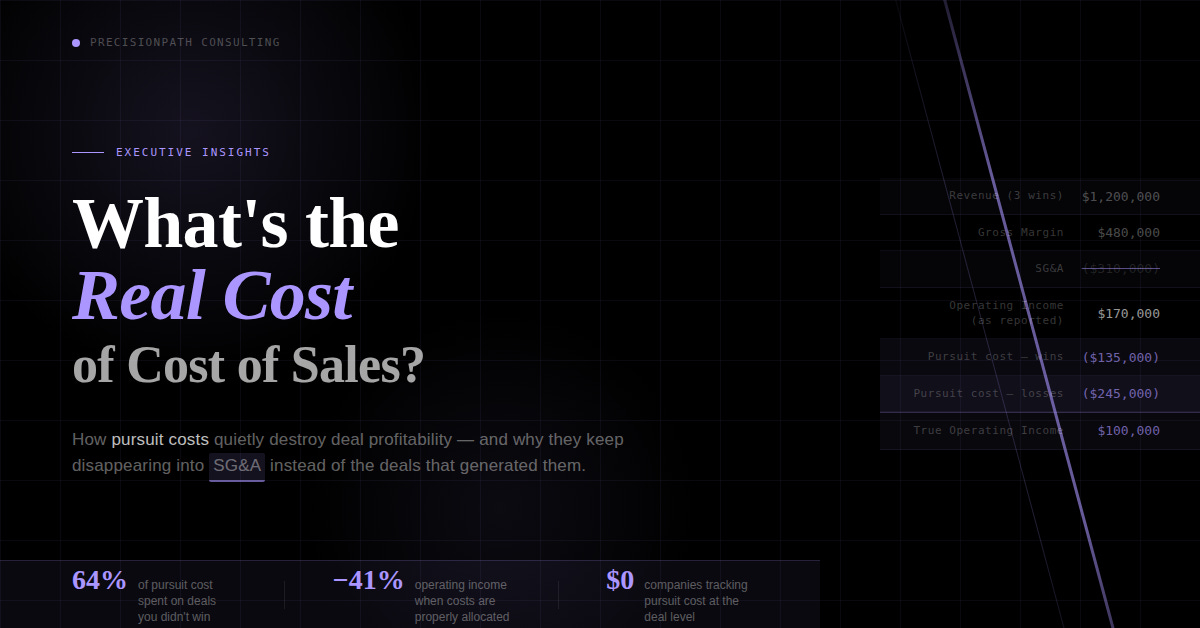
THE DEAL AS IT APPEARS IN THE P&L
Average contract value (3 wins) $1,200,000
Estimated gross margin (40%). $480,000
SG&A (reported at company level). ($310,000)
Operating income (as reported). $170,000
THE DEAL WITH PURSUIT COSTS ALLOCATED
Average contract value (3 wins). $1,200,000
Estimated gross margin (40%). $480,000
Pursuit cost — 3 wins @ $45K each. ($135,000)
Pursuit cost — 7 losses @ $35K each. ($245,000)
Total pursuit cost burden. ($380,000)
True operating income. $100,000
Same company. Same year. Same revenue. The operating income just dropped by 41% — not because anything changed, but because we finally looked at the full cost of the chase.
And here is the part that should stop you: $245,000 of that cost — 64% of the total pursuit expense — was spent on deals you didn’t win.
“The cost of the deals you lost is being paid by the deals you won. Most companies never see that math.”
This isn’t a hypothetical. This is how the economics of sales-intensive businesses actually work. The question is whether you’re managing it — or just absorbing it.
The Deal That Looks Right But Costs Everything
Here’s the pattern I see most often in growing companies: the pursuit problem isn’t evenly distributed. It concentrates around a specific type of deal.
The big one.
The transformational contract that would change the trajectory of the business. The logo that would open doors. The revenue that would let you finally hire the team you’ve been understaffing. Everyone in the organization can feel the pull of it.
And so the company chases it. Hard. For months. Pulling in executives, stretching the pre-sales team, building custom proposals and decks and demonstrations. The CEO is on calls. The CFO is reviewing terms. Half the leadership team has touched it in some form.
And then the deal either closes — at margins that got compressed in negotiation because you wanted it too badly — or it doesn’t close, and all of that pursuit cost disappears quietly into SG&A like it never happened.
Either way, nobody runs the post-mortem on what it actually cost to chase that deal. Nobody asks whether the executive hours spent on a pursuit that stalled for six months would have been better allocated elsewhere. Nobody calculates the pipeline that didn’t get worked because the team’s attention was consumed by the big one.
The Prestige Deal Trap
The larger and more visible the deal, the more likely pursuit costs are to be dramatically underestimated. Large deals require more stakeholders, more custom work, longer sales cycles, and more executive involvement — all of which are expensive. They also compress margins in late-stage negotiation because by the time you’ve invested six months of pursuit cost, the sunk cost psychology kicks in and rationality leaves the room.
The Real Cost of Poor Qualification
If pursuit costs are real and significant, then the decision of which deals to pursue deserves the same rigor as any other capital allocation decision. But in most organizations, it doesn’t get that.
Sales qualification frameworks exist — MEDDIC, BANT, Challenger, and a dozen others. Most sales teams know them in theory. Very few apply them with the financial discipline the decision actually requires.
The question that should anchor every deal qualification conversation isn’t ‘can we win this?’ It’s ‘what will it cost us to find out if we can win this, and is that investment justified by the probability and value of the outcome?’
That’s a different question. It requires attaching a number to the pursuit before the pursuit begins. It requires estimating, even roughly, how much internal resource this deal will consume at each stage. And it requires someone with authority to say ‘this isn’t worth what we’d have to spend to win it.’
“Not pursuing a deal is a decision. Most companies treat it as a failure. The companies with the best true margins treat it as discipline.”
The organizations that do this well share one characteristic: they have genuinely internalized that a lost pursuit is not a zero-cost event. It cost something. The question is whether it cost the right amount for the right probability.
When that discipline is absent, sales teams chase volume because volume is what’s measured. The pipeline gets loaded with deals that feel good but consume disproportionate resources. Win rates stay flat, pursuit costs compound, and true margins erode — all while the top-line revenue trend looks acceptable.
What Gets Measured Gets Managed. What Doesn’t Gets Subsidized.
The reason pursuit costs end up in SG&A isn’t malicious. It’s structural. Tracking pursuit costs at the deal level requires discipline that most growing companies haven’t built yet. It requires sales teams to log hours. It requires leadership to estimate time allocation. It requires someone to do the math that the accounting system never does automatically.
It’s easier to let it aggregate. And so it does.
But here is what that convenience costs you strategically: when pursuit costs live in SG&A, they become a management problem instead of a sales problem. The CFO looks at an SG&A ratio that seems high and asks for budget cuts. Headcount gets scrutinized. Travel gets restricted. Tools get canceled. And none of those interventions touch the actual driver of the cost, which is the volume and quality of deals being pursued.
You end up managing the symptom — SG&A as a percentage of revenue — instead of the cause, which is an undisciplined pursuit strategy that is spending real capital on the wrong opportunities.
The hidden cost multiplier most companies miss
Pursuit costs don’t just affect the deals you lose. They affect the deals you win. When your best salespeople and pre-sales engineers are consumed by a six-month pursuit, they are not working other pipeline. The opportunity cost of their time — the deals that didn’t get pursued, the relationships that didn’t get developed, the renewals that didn’t get the attention they needed — compounds the cost of a poor pursuit decision in ways that never appear on any report.
Making Pursuit Costs Visible Without Building a Bureaucracy
The solution here is not to add a layer of administrative overhead that frustrates your sales team and slows down your pipeline. It’s to build a lightweight framework that makes pursuit economics visible at the decision point, not in the post-mortem.
Three things that work in practice:
01 Assign a pursuit cost tier to every deal at qualification.
Not a precise number — a tier. Low (under $10K internal cost to pursue), Medium ($10K–$40K), High (over $40K). The discipline of assigning the tier forces the conversation about what this deal will actually demand from the organization. Tier assignments should be based on deal complexity, required customization, sales cycle length, and executive involvement expected.
02 Track executive time as a pursuit cost, not overhead.
CEO and COO time is the most expensive and most consistently undervalued line in a pursuit budget. When a senior executive spends four hours on a sales call, a proposal review, and a client dinner for a single deal, that is a real cost. Even a rough estimate — based on total compensation divided by working hours — attached to the deal gives the team a more honest picture of what the organization is investing.
03 Run a quarterly pursuit cost reconciliation.
At the end of each quarter, calculate total estimated pursuit cost by segment: deals won, deals lost, and deals still active. Compare it to gross margin on won deals. If you find that pursuit cost on lost deals is exceeding 20–25% of gross margin on won deals in the same period, you have a qualification discipline problem that no hiring plan, commission restructure, or SG&A budget cut will fix.
None of these require a new system. None of them require a dedicated analyst. They require a decision that pursuit economics matter and a commitment to spending thirty minutes per quarter actually looking at the numbers.
The Deeper Strategic Question
There is a harder conversation underneath all of this that most organizations aren’t having.
If you were to allocate pursuit costs accurately to every deal in your pipeline — if every opportunity had a real, estimated cost of chase attached to it — which deals would you still pursue?
For most companies, the honest answer is: fewer than they currently are.
Not because their sales team is undisciplined or their pipeline is poorly managed. But because deal pursuit decisions are almost universally made on revenue potential and win probability without a third variable: the cost and distraction of the pursuit itself.
Add that third variable and the math changes. The $200,000 contract that requires a six-month pursuit and heavy executive involvement might be less profitable at the deal level than three $80,000 contracts that close in six weeks with minimal pre-sales effort. But nobody is running that comparison because the pursuit costs of the first deal are invisible.
“Revenue potential without pursuit cost is like evaluating a real estate investment by looking only at the sale price. The number that matters is what’s left after you account for what it cost you to get there.”
The companies that figure this out — that build pursuit economics into their go-to-market discipline — don’t just improve their margins. They improve their team’s focus. They reduce the exhaustion that comes from chasing deals that drain energy without delivering returns. They get better at saying no, which is the only way to get better at saying yes to the right things.
The Number That’s Been There All Along
Cost of sales as a line item will always look cleaner than the reality of what selling actually costs. The accounting will always be tempted to aggregate, to smooth, to make the P&L readable at the expense of making it honest.
But the real cost of cost of sales isn’t in the number on your income statement. It’s in the number that doesn’t appear anywhere — the capital your organization spent pursuing the wrong deals, the executive hours absorbed by pursuits that were never likely to close, the pipeline that didn’t get worked while the team was distracted by the deal that felt important but wasn’t profitable.
That number has been there all along. You’ve just been calling it SG&A.
“The question isn’t whether you can afford to track pursuit costs. It’s whether you can afford not to.”
If this is a conversation your leadership team hasn’t had yet, it’s worth having. Not because the accounting is broken — but because the decisions being made downstream of that accounting are being made with incomplete information. And in a market that’s moving as fast as north DFW is right now, incomplete information has a cost too.
About PrecisionPath Consulting
PrecisionPath helps executive teams in north DFW diagnose the gaps between strategy, leadership, and execution — and build a clear, practical plan to close them. If your organization is growing fast and starting to feel the friction of decisions being made without the full picture, we’d like to talk.
precisionpathllc.com • info@precisionpathllc.com • “Built for Leaders Who Refuse to Guess.”