

The Accountability Gap
Why leaders who create the mess don’t clean it up — and what that costs everyone else.
This series examines the structural and cultural reasons why executives who make the decisions that lead to layoffs, failed strategies, and broken trust rarely face the same consequences as the people around them. The language, the boards, the human cost, and what accountability actually looks like when leaders choose it.
Issue 01 — You Know the Calendar Invite
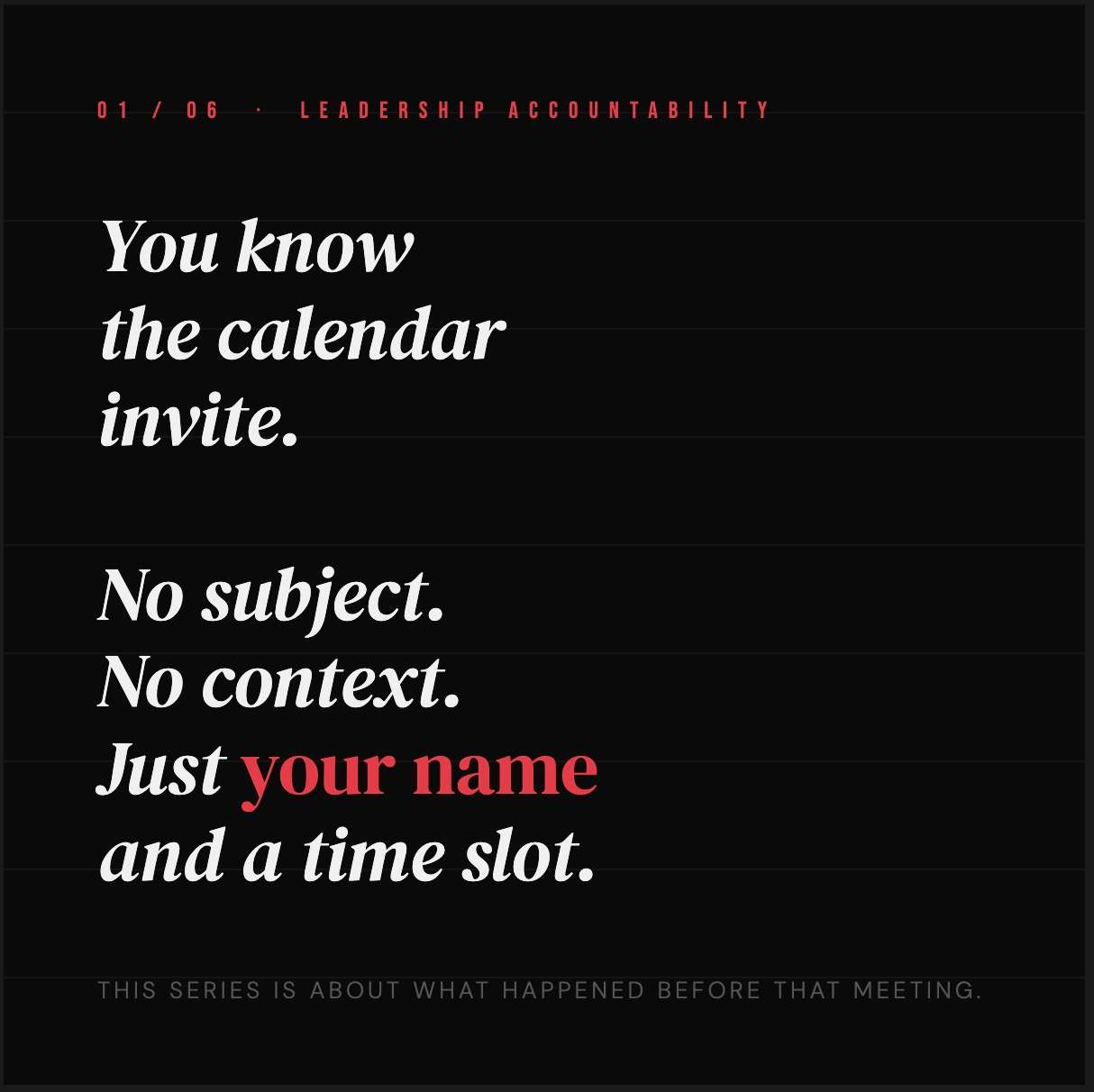
You know the calendar invite.
No subject line. No context. Just your name and a time slot — and a manager you haven’t heard from in weeks.
You spend the next hour convincing yourself it’s fine.
It’s not fine.
Somewhere between the Zoom link and the carefully rehearsed script about restructuring and difficult decisions, you realize your job is gone. The person reading that script still has theirs.
Think about that.
They hired too fast. Forecast wrong. Chased a strategy that didn’t hold up. And when the bill came due — you paid it.
“This isn’t about bitterness. It’s about accountability. The kind that seems to apply to everyone in an organization except the people at the top who made the calls that led to that meeting.”
Layoffs don’t happen in a vacuum. They are the end of a chain of decisions. Someone decided to hire aggressively during a growth period without building in the discipline to sustain it. Someone approved headcount that was tied to a forecast that turned out to be optimistic at best. Someone had the opportunity to slow down and didn’t, because slowing down felt like falling behind and falling behind had consequences — just not the kind that showed up on a calendar invite.
By the time the announcement comes, the language has been laundered. It’s not “we made bad calls” — it’s “the macroeconomic environment has shifted.” It’s not “we overhired” — it’s “we’re right-sizing for the next chapter.” Every phrase is designed to spread responsibility so thin that it disappears entirely.
And the person who wrote that script goes back to their desk.
That’s what this series is about. Not the layoffs themselves — those will keep happening. But the accountability gap between the people who make the decisions and the people who live with the consequences.
Next issue: the language companies use to make sure nobody is responsible for anything — and why we keep letting them get away with it.
This is post 1 in the Accountability Gap series — part of The Execution Gap newsletter. Follow for the full series. #Leadership #Accountability #WorkplaceCulture #LeadershipDevelopment #TheExecutionGap
Issue 02 — The Language of Avoidance
Learn the words. They’re doing a specific job.
“Restructuring.” “Right-sizing.” “Workforce optimization.” “Difficult macroeconomic environment.” These aren’t just corporate jargon — they are a system of language specifically engineered to ensure that no individual is accountable for anything.
When a company “right-sizes,” nobody made a mistake. The company simply grew to a size that was no longer right, and now it is correcting. Passive voice. No actor. No decision-maker. No one to answer for it.
When the “macroeconomic environment” is cited as the cause, the market did this. External forces. Nobody in that boardroom, nobody on that leadership team, nobody who approved three consecutive quarters of aggressive hiring — they’re bystanders too.
“Every sanitized phrase puts distance between a leader and a decision they made. By the time it reaches you — in that meeting, with that script — accountability has been laundered completely.”
This language doesn’t emerge accidentally. It is drafted by communications teams, reviewed by legal, approved by the CEO, and delivered with just enough visible emotion to seem human. The crack in the voice. The “this was the hardest decision I’ve ever had to make.” The acknowledgment that “these are talented people.”
All of it is designed to move the moment from a reckoning to a transition. From accountability to inevitability.
The next time you read a layoff announcement, strip the language back to what it actually says. Someone hired people and is now unhiring them. Someone made projections that didn’t hold. Someone built a strategy that didn’t work. Those are the facts underneath the words.
Naming them clearly is the first step toward expecting better.
This is post 2 in the Accountability Gap series — part of The Execution Gap newsletter. Follow for the full series. #Leadership #Accountability #WorkplaceCulture #TheExecutionGap
Issue 03 — The Board Complicity Problem
Here’s what doesn’t get said enough.
Layoffs don’t just let leaders keep their jobs. Sometimes they strengthen their position.
Cut 10% of the workforce and the stock ticks up. Analysts describe it as decisive action. The board nods approvingly. The CEO who presided over two years of reckless hiring is suddenly celebrated for fiscal discipline. The same behavior that created the problem — unchecked growth, weak forecasting, poor strategic judgment — is reframed as its solution.
This is not an accident of perception. It is the system working exactly as designed — just not for the people who lost their jobs.
“Boards are supposed to hold leaders accountable. Instead they often validate the move, approve the severance packages, and issue a statement about the company being well-positioned for the future.”
The structural problem is straightforward: boards are largely composed of people who think like the executives they’re meant to oversee. They share frameworks, networks, and incentives. They evaluate a layoff announcement through the lens of how it will be received by investors, not how it will be experienced by the person who has to explain to their family what just happened.
A board that genuinely held leaders accountable would be asking different questions before the announcement: How did we get here? What decisions led to this overhang? What could have been done differently, and when? Who approved the headcount that’s now being cut?
Those questions rarely get asked. And so the pattern repeats — overhire, underperform, cut, recover, repeat — while the same leadership teams collect their bonuses and their praise for difficult decisions.
Until governance structures actually demand accountability for the decisions that lead to layoffs — not just the optics of how they’re handled — nothing changes.
This is post 3 in the Accountability Gap series — part of The Execution Gap newsletter. Follow for the full series. #Leadership #Accountability #CorporateGovernance #TheExecutionGap
Issue 04 — The Human Math
The press release calls it a reduction in force of approximately 2,000 positions.
Here is what that actually is.
It is 2,000 people who have to have a conversation tonight that they were not planning to have. It is 2,000 people checking what happens to their health insurance — not eventually, right now, today. It is 2,000 people doing the math on their savings against their mortgage and coming up short. It is 2,000 people who took this job because someone sold them on the mission, the culture, the trajectory, and who are now wondering what that was worth.
Numbers flatten people. That is partly their function — to make a human situation feel like a financial one. Two thousand is a manageable abstraction. Two thousand specific faces, two thousand specific families, two thousand specific moments of being told — that is harder to sit with.
“Leaders who have never personally felt that math make these calls differently than leaders who have.”
That is not an accusation. It is an observation about proximity. If your job was never in question — not for a single day during this process — it is genuinely difficult to fully understand what you just did to someone else’s life. The difficulty is real. But the difficulty does not reduce the responsibility.
The least we can ask is that the people making these decisions try to hold that weight honestly. Not performatively — not the rehearsed voice crack on the all-hands call — but genuinely. In the room where the decision gets made. Before the language gets cleaned up. When it’s still possible for the reality to change the outcome.
2,000 people. Each one a decision someone made, and someone didn’t.
This is post 4 in the Accountability Gap series — part of The Execution Gap newsletter. Follow for the full series. #Leadership #Accountability #PeopleFirst #TheExecutionGap
Issue 05 — What Accountability Actually Looks Like
It exists. It is just rare enough to be remarkable.
There are leaders who, facing the prospect of cuts, have taken significant personal pay reductions first. Not token gestures — real reductions, sustained for real periods, before a single employee was let go. There are leaders who have stood in front of their organizations and said, plainly and without the hedge language, that they made the wrong call and they own it. There are leaders who have clawed back bonuses, eliminated executive perks, and restructured their own compensation before restructuring their workforce.
These stories don’t generate the same coverage as the big layoff announcements. They don’t move the stock in a way that analysts notice. They are often described, when they’re described at all, as unusual — which is itself the problem.
“Accountability isn’t weakness. It’s not bad optics. It’s the thing that determines whether the people who stay actually believe in what they’re building.”
The organizations where leaders have demonstrated this kind of accountability tend to have something that most companies spend enormous resources trying to manufacture: actual trust. Not the trust that comes from a well-produced all-hands or a slick employer brand campaign — the kind that comes from watching someone absorb a consequence rather than redirect it.
People remember that. They remember it when they’re deciding whether to give discretionary effort. They remember it when they’re deciding whether to stay. They remember it when they’re building their own teams and deciding what kind of leader they want to be.
The bar for this kind of leadership is not high. Which is the most damning thing about how rarely it gets cleared.
This is post 5 in the Accountability Gap series — part of The Execution Gap newsletter. Follow for the full series. #Leadership #Accountability #LeadershipDevelopment #Trust #TheExecutionGap
Issue 06 — What Good Leadership Looks Like Before It Gets Here
The best time to prevent a layoff is never the day you’re announcing one.
It is the moment, somewhere in the middle of a growth cycle, when someone says the company should double its headcount to capture the opportunity — and a leader in the room says: are we sure? Not to be contrarian. Not because they don’t believe in growth. But because they understand that headcount is not a reversible decision in the way that a marketing budget or a software contract is, and they want the confidence to match the commitment.
It is the budget meeting where the aggressive forecast gets challenged instead of celebrated. Where someone asks what the downside scenario looks like and insists on a real answer rather than a reassuring one.
It is the decision to hire for what the business needs today, with buffers that account for what could change — rather than hiring for the growth story being told to investors and hoping the story holds.
“The best leaders understand that their job is not just to perform in the good moments. It is to build organizations that can survive the hard ones without making the people who showed up every day pay for decisions they had no part in making.”
These leaders are not on the cover of business magazines for their bold vision. They don’t go viral for their all-hands speeches. The thing they’re most known for, by the people who’ve worked for them, is that their people still have jobs.
That is not a small thing. In a landscape where restructuring has become a default rather than a last resort, where right-sizing is treated as strategy rather than failure, where the language has become so practiced that nobody flinches anymore — choosing to lead differently is a genuine act of courage.
It requires saying no when yes is easier. It requires slowing down when everyone else is sprinting. It requires caring about what happens to people when the story doesn’t go the way you planned.
The accountability gap closes one decision at a time. Most of those decisions happen long before anyone writes a press release.
Thank you for reading The Execution Gap.
If this series resonated with you, share it with someone who needs to read it.
This is the Accountability Gap series — part of The Execution Gap newsletter. .#Leadership #Accountability #LeadershipDevelopment #WorkplaceCulture #TheExecutionGap